
Project description
Namsal proposes a watershed resilience hub in the Nyamwamba area. Riverbank restoration, nurseries, beekeeping, clean cookstoves, recycling and sanitary-pad production connect with solar energy, rainwater capture and community early-warning systems.
Explore the community context, existing work and development plans described by the project.
More project details
- Traditional Authority
- Kingdom (King)
- Primary Ecosystem
- Watershed / Mountain ecosystem / Agricultural landscape
- Community estimate
- ~850,000 (over 80% in smallholder agriculture)
- Reported direct beneficiaries
- 1,500 farmers, youth, women, and students
- Reported indirect beneficiaries
- ~7,500 family and community members
- Planned Reach (5–10yr)
- 15,000+ across Kasese District
- Training Completed
- Earth Awareness · Nursery Management
Community Context
Namsal Climate Concern International works in Nyamwamba Division, Kasese Municipality, in Uganda's Rwenzori region - a mountainous, densely populated district where more than 80% of roughly 850,000 people depend on smallholder agriculture. The community sits in the watershed of the Nyamwamba River, which descends from the Rwenzori Mountains and has a history of destructive flooding and landslides that threaten lives, crops, and infrastructure.
The community faces a convergence of pressures: deforestation, soil degradation, recurrent flooding, and the long environmental shadow of the Kilembe Mines. The project's priorities are to restore degraded riverbanks and slopes, reduce flood and landslide risk, diversify livelihoods away from disaster-vulnerable agriculture, and build the community's capacity to anticipate and withstand climate shocks.
Back to sections ↑Ecological Landscape
Kasese lies in a watershed and mountain ecosystem of high ecological significance, fed by the glaciers and rivers of the Rwenzori range. The area's natural assets - forests, rivers and watersheds, fertile agricultural land, wildlife habitats, and mineral deposits - are under significant strain.
Current environmental pressures include:
- Deforestation, driven substantially by charcoal and firewood demand
- Soil degradation from poor farming practices on steep terrain
- Flooding and landslide risk along the Nyamwamba and its tributaries
- Biodiversity loss
- River contamination and chemical/heavy-metal pollution linked to mining activity
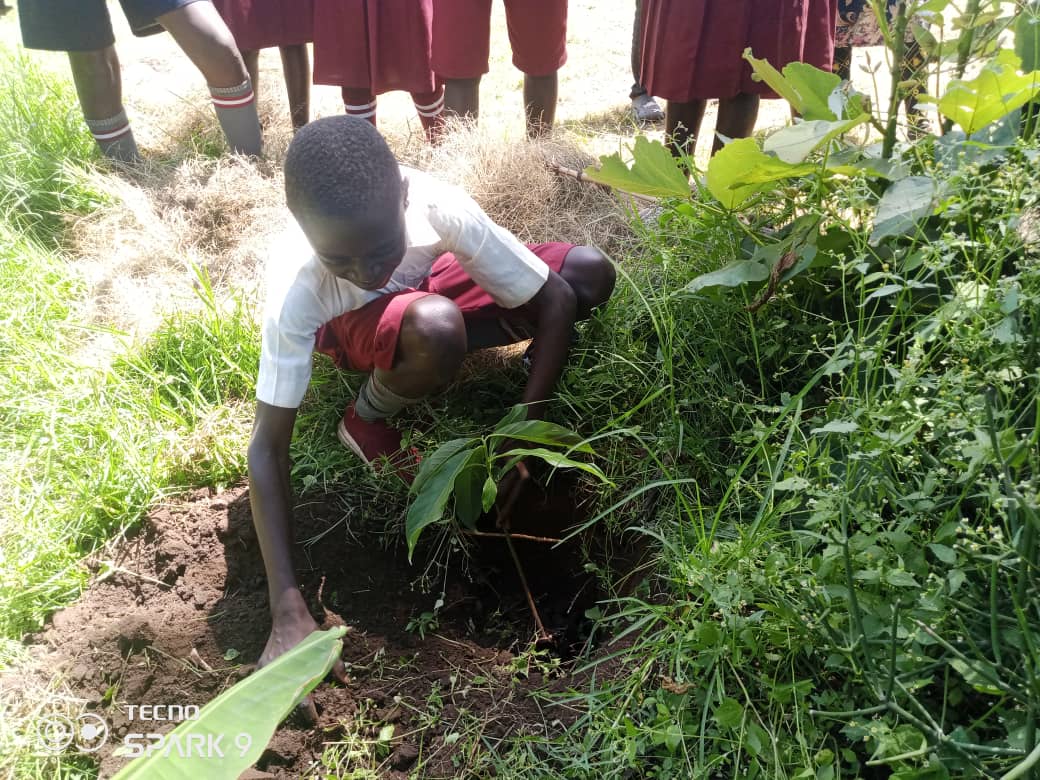
The project's restoration strategy centers on a tree nursery producing 200,000+ native, fruit, coffee, and cocoa seedlings to reforest degraded riverbanks and slopes, reducing flood and landslide risk; agroforestry to reverse soil degradation; a plastic recycling unit to keep waste out of drainage channels; and clean-cooking solutions to curb deforestation from charcoal production.
Back to sections ↑Regional Economic Context
The regional economy is driven by agriculture, livestock, forestry, fishing, mining, tourism, and local trade. The district's natural resources include forests, rivers and watersheds, fertile agricultural land, wildlife habitats, and significant mineral deposits.
Mining is a defining feature of Kasese's environmental landscape:
- Kilembe Mines - a large copper and cobalt mine established in the 1950s. Industrial-scale extraction ceased in the early 1980s, but the site remains a significant source of contamination: acid mine drainage and tailings carry heavy metals including copper, cobalt, lead, and arsenic into the Nyamwamba River, with reported crop wilting, elevated health risks, and waterborne disease among downstream communities. The government is currently seeking investors to revive operations.
- Artisanal gold mining in Maliba Sub County, processing gravel from deposits traced to the Rwenzori Mountains.
- Artisanal limestone mining in Muhokya, producing lime and aggregate from calcrete and tufa deposits in the Lake George Basin.
- Sand mining - manual and artisanal, along nearly all rivers in the district, for construction.
The concept note identifies mining-related contamination, deforestation, abandoned workings and soil degradation as concerns for the Nyamwamba watershed. The submission also records community concerns about health and agricultural exposure. The project responds through agroforestry, beekeeping, recycling and women-led manufacturing.
Back to sections ↑Core Project Systems
The project develops eight interconnected systems, designed to restore the watershed while building diversified, self-sustaining livelihoods.
Tree Nursery & Agroforestry Program
Production of 200,000+ native, fruit, coffee, and cocoa seedlings for reforestation, flood mitigation, and soil stabilization, paired with agroforestry training in composting, contour planting, and terracing.
Beekeeping Training Initiative
A demonstration apiary of 20–30 hives with training in modern beekeeping and honey processing, plus starter kits to launch beekeeping as an alternative livelihood. A revolving fund - in which beneficiaries contribute a portion of honey proceeds to replenish kits for new farmers - allows the program to expand without ongoing donor dependence.
Clean Cooking Solutions
Demonstration and production of improved Lorena cookstoves to reduce the charcoal and firewood demand driving deforestation, with community members trained to build and sell stoves.
Plastic Recycling Unit
A small-scale, solar-powered recycling plant processing plastic waste into crafts, pavers, toothbrush handles, and kitchen utensils. The unit reduces plastic clogging drainage channels (a flood driver), creates green jobs for youth, and generates revenue toward the center's long-term financial sustainability. A youth-run paid collection enterprise supplies its raw material while formalizing local waste management as a livelihood.
Banana-Fiber Sanitary Pad Production
Training women and girls to produce affordable, biodegradable sanitary pads from locally abundant dried banana fiber. Dried banana stems - agricultural waste otherwise discarded - are collected from local farms for fiber extraction, sterilization, pad assembly, and packaging. The enterprise addresses menstrual hygiene poverty, reduces disposable-pad plastic waste, and establishes women-led income.
Solar Power & Rainwater Harvesting
A solar system and 10,000-liter water tank providing energy independence and water security for the nursery and center.
Climate Research & Learning Center
Weather instruments (thermometers, rain gauges, barometers, anemometers, sling psychrometers), internet, and reference materials for scientific research and weather education - feeding an early-warning channel that shares flood and landslide alerts via community WhatsApp groups, local radio, and village leaders.
Training & Capacity Building
A training hall and demonstration plots for farmer field schools, awareness campaigns, and hands-on learning - reinforced by a community-based trainer network of farmers and youth who become volunteer peer trainers, extending reach well beyond the 1,500 direct beneficiaries, and a school outreach program establishing tree-planting clubs, student-led weather monitoring, and pad distribution.
Back to sections ↑Implementation Strategy - Five-Year Phased Approach
Phase 1 (Year 1): Center setup and infrastructure; land preparation and site development; construction of nursery, training space, and basic facilities; installation of solar and water systems; farmer training in tree planting, organic farming, and nursery management; strengthening of farmer groups and youth engagement.
Phase 2 (Year 2): Establish beekeeping unit (20–30 hives) and conduct beekeeping training; establish the science research center; launch banana-fiber pad training for women and girls; establish school outreach (tree-planting clubs); continue tree-planting and organic-farming training.
Phase 3 (Year 3): Train community members to build Lorena cookstoves; establish the community-based trainer network; set up market linkages for honey, pads, and recycled products; establish soil-conservation demonstration plots; continue tree-planting and beekeeping training.
Phase 4 (Years 4–5): Install the small-scale recycling plant; train youth in plastic collection and sorting; launch the paid youth waste-collection enterprise; develop recycled-plastic products; establish the early-warning radio channel; continue cookstove and farmer training.
Back to sections ↑Three Pillars of Sustainability
Social
The project improves education through the weather research center and school tree-planting clubs; advances health via clean cookstoves that reduce respiratory illness and banana-fiber pads that protect menstrual health; empowers 200+ women with income-generating skills; develops youth through recycling jobs and training; and strengthens infrastructure with rainwater harvesting, solar power, and cleared drainage that reduces flooding. Reduced disaster losses and less time spent collecting fuelwood lower household costs, while early-warning systems reduce anxiety and girls gain the dignity of attending school during menstruation.
Environmental
The project restores ecosystems through a nursery producing 200,000+ seedlings for riverbank and slope reforestation, stabilizing soil and reducing flood and landslide risk. Agroforestry training restores soils through composting, contour planting, and terracing; beekeeping supports pollinator biodiversity; clean cookstoves cut deforestation; the recycling unit keeps plastic out of waterways and drainage; and banana-fiber pad production turns agricultural waste into value. Together these restore watershed health, increase tree cover, and build a culture of environmental stewardship.
Financial
The project diversifies livelihoods and builds sustainable enterprises: agroforestry provides coffee, cocoa, and fruit seedlings for long-term income; beekeeping generates honey sales sustained by a revolving fund; the recycling unit creates green jobs in collection and manufacturing; banana-fiber pad production establishes women-led businesses; and cookstove training creates another income line. Market linkages connect beneficiaries to shops, health centers, and cooperatives. Together these reduce dependence on disaster-vulnerable agriculture, create 100+ direct and indirect jobs, and keep income circulating within Kasese District.
Back to sections ↑Role Within the Country Platform
The project serves as a replicable climate-resilience model for Uganda's most vulnerable districts. The tree nursery can supply seedlings for regional reforestation beyond Kasese, supporting national forest-cover targets, and the center can function as an agricultural training hub for farmers, extension workers, and local government staff across the Rwenzori region.
The banana-fiber pad model is nationally adaptable for menstrual hygiene poverty, and the recycling unit demonstrates circular-economy principles aligned with Uganda's National Environment Management Authority (NEMA) waste-reduction goals. Youth vocational training in recycling, beekeeping, pad making, and cookstove production builds a skilled green workforce, supporting the priorities of Uganda's National Development Plan (NDP III) for job creation, climate action, and sustainable industrialization.
Potential Synergies With Other Projects
As a regional climate-resilience model, the project can supply seedlings to reforestation initiatives beyond Kasese, host farmers and extension workers as a training hub, and share its banana-fiber pad and circular-economy recycling models for adoption elsewhere. Its youth vocational training in recycling, pad making, beekeeping, and cookstove production contributes to a regional green workforce, and its market-linkage and early-warning systems offer templates other Rwenzori-region communities can replicate.
Back to sections ↑Collaboration Needs
The project's priority needs are:
- Technical expertise in small-scale plastic recycling, banana-fiber processing, and modern beekeeping (hive management and honey processing)
- Institutional partnerships with the Uganda National Meteorological Authority (UNMA) and universities such as Makerere to support the weather research center
- Seed supplies of native, fruit, coffee, and cocoa varieties, ideally through the National Forestry Authority (NFA)
- Backup water and energy systems to reinforce the planned solar and rainwater infrastructure
- Transportation - a reliable vehicle or motorcycle for monitoring, seedling distribution, and market linkages
- Training in business skills, financial literacy, and cooperative management to maximize beneficiary income
Community Leadership & Governance
Project Lead: Sadro Ngorokoro - Namsal Climate Concern International Local Partners: To be developed Community Groups: To be developed Training Completed: Earth Awareness · Nursery Management
Back to sections ↑